ONE PLATFORM FOR ALL SAFETY TECHNOLOGY
The Florida Department of Education (FLDOE), in cooperation with the Florida Department of Management Services (FLDMS), is implementing a statewide initiative to enhance school emergency communications and strengthen coordination between schools, first responders and the State of Florida.
As an enhancement to Alyssa’s Law, this deployment follows the passage of Florida Senate Bill 1470, Amendment 777016 (2025):
Subject to an appropriation, the Department of Education, in cooperation with the Department of Management Services, shall identify a centralized system for use by all public safety answering point infrastructure which can receive alerts from all panic alert systems and integrate digital maps used by public schools, charter schools, and other educational institutions.
The centralized system must:
Each public school and charter school shall confirm with the district school board that the school’s respective panic alert system is connected to the centralized system. Panic alert systems must be integrated with the centralized system to ensure seamless notification of law enforcement and emergency responders. Digital maps required under s. 1013.13 must also be integrated with the centralized system to support emergency response.
Your role in FLSCAP is vital. Here is a breakdown on how FLSCAP creates
an organized ecosystem for everyone

Real-time critical data integration straight to dispatch.
Transform your response capabilities with a unified intelligence feed. By integrating disparate data sources directly into a single platform, we eliminate critical blind spots during high-stakes emergencies.
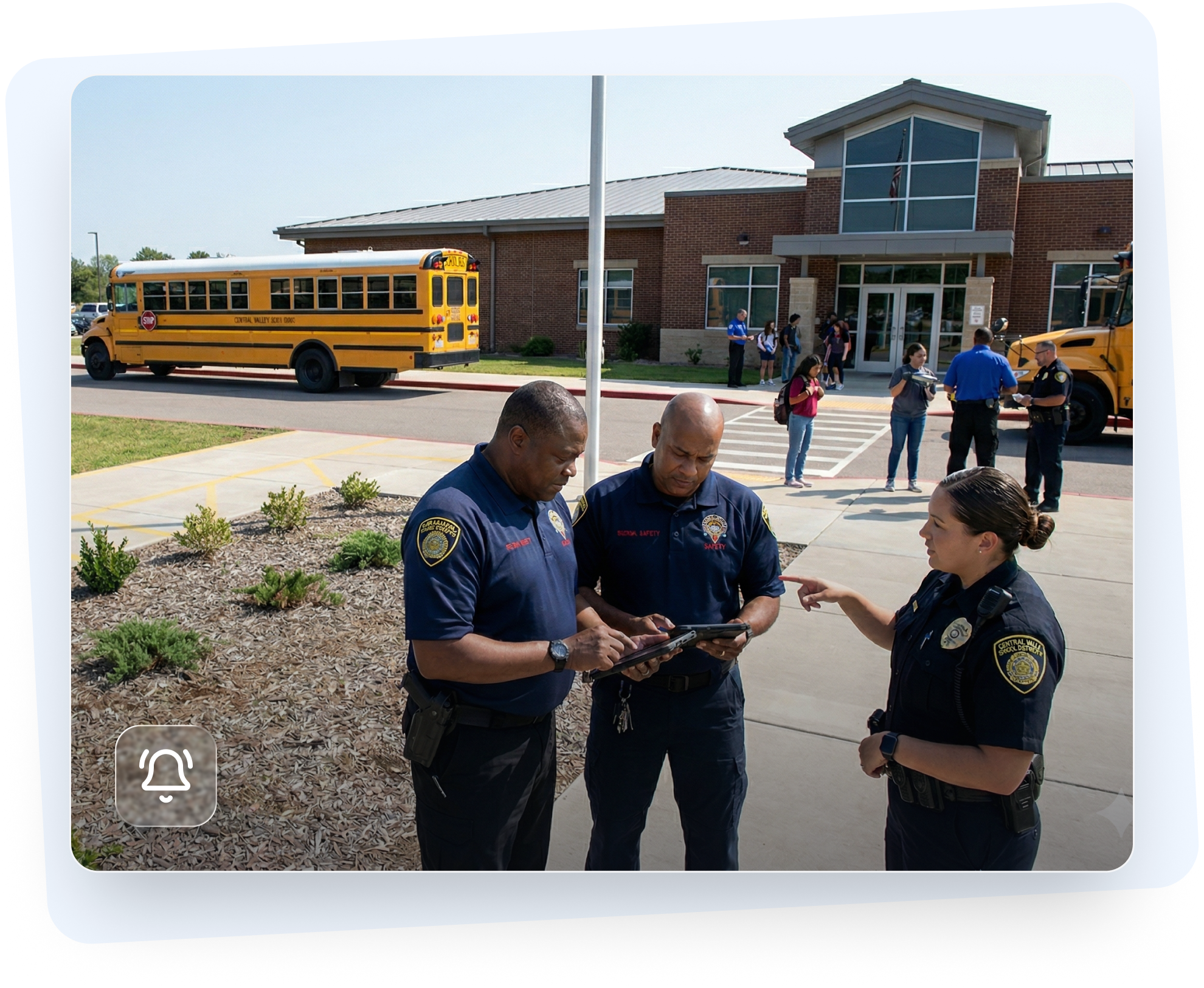
Comprehensive ecosystem connecting campus infrastructure to local agencies.
Ensure the highest standard of safety for students and staff. Our platform bridges the gap between your school's physical security infrastructure and first responders, facilitating instantaneous communication when every second counts.

Secure API connections extending the reach of physical security platforms.
Supercharge your hardware and software offerings. By utilizing our open architecture, you can transform standalone cameras, sensors, and access control systems into active nodes within a broader emergency response network.
PSAPs/911 FAQ
Florida’s Statewide Centralized Alert Platform replaces the need to monitor multiple systems. Instead of logging into different platforms, the centralized system consolidates all alerts into a single interface, reducing workload, training complexity, and response time.
No. The Statewide Centralized Alerting Platform is designed to simplify operations. It standardizes workflows, eliminates duplicate systems, and streamlines alert handling.
Alerts are automatically routed based on verified GPS/geolocation and the associated jurisdiction, ensuring the correct PSAP receives the alert instantly without manual intervention. The FLSCAP system is also capable of notifying primary, secondary and tertiary PSAPs.
Yes. The FLSCAP system is also capable of notifying primary, secondary and tertiary PSAPs. The 911 county coordinator and site managers can determine the alerting preferences desired for each location within their jurisdiction.
Yes, but through a single standardized format, eliminating the need to learn or manage different vendor systems. The FLSCAP platform will even support future alert systems that may not currently be utilized in your county or jurisdiction.
Yes. The platform enables simultaneous visibility across PSAPs, law enforcement, school security and school administrators, improving coordination during incidents.
Alerts include:
The state will provide standardized training and ongoing support, reducing the need to train on multiple systems.
Alerts are received in under 10 seconds from the time a panic button is pressed, ensuring near real-time response.
The Statewide Centralized Alerting Platform can automatically notify multiple PSAPs and agencies simultaneously, based on jurisdiction and predefined rules.
No. The Statewide Centralized Alerting Platform standardizes workflows, training, and alert handling, eliminating inconsistencies across systems.
Yes. PSAPs can claim, acknowledge, and manage alerts directly within the platform across web and mobile interfaces.
The Statewide Centralized Alerting Platform is built on redundant, geographically distributed cloud infrastructure with 99.999% uptime, ensuring continuous availability. Backup systems and failover protocols maintain operations even during outages.
No. The platform is designed to integrate alongside existing CAD systems, enhancing - not replacing - current workflows.
The system allows for:
This helps PSAPs quickly assess and prioritize incidents.
Yes. PSAPs can configure:
School District FAQ
No. FLSCAP is vendor-agnostic and integrates with existing systems.
No. All school panic alert systems must connect to FLSCAP to ensure interoperability and compliance. However, you can continue using your preferred vendor; the platform integrates with all approved systems.
It provides:
Yes. The platform integrates digital school maps and floor plans, giving responders real-time visual context during emergencies.
Access is controlled through role-based permissions, and data is only accessible to authorized school, local, and state agencies.
Yes. The platform complies with FERPA, HIPAA, and CJIS best practices, with encrypted data and secure cloud infrastructure.
No. Implementation is phased and includes integration, testing, and training to ensure a smooth transition.
Yes. Schools will participate in scheduled system testing, and PSAPs will be notified prior to any tests to ensure coordination.
Data retention is typically 365 days, but policies can be customized based on district or law enforcement requirements.
The school district or agency owns its data, with secure access provided only to authorized users.
No. Location tracking is only active during an initiated emergency, protecting user privacy.
Training includes:
Schools must be connected to meet state compliance requirements. Districts and the state will verify that all systems are properly integrated.
During implementation:
Yes. The platform can also support:
Minimal. Integration is supported by the platform team, with structured onboarding and support throughout deployment.
Vendor FAQ
Yes. Vendors continue to provide their solutions, but must integrate with FLSCAP to ensure statewide connectivity.
Vendors must support secure integration methods such as:
This ensures consistent alert delivery and display across all agencies.
No. The platform is designed to be open and interoperable, allowing multiple vendors to participate while ensuring a unified response system.
All incoming alert data is normalized into a single format, ensuring consistency for PSAPs and responders regardless of source system.
Yes. The system supports future integrations such as:
Vendors continue to:
Yes. Organizations can toggle integrations on or off by location, allowing flexibility in deployment.
The platform is designed for 99.999% uptime, with redundant cloud infrastructure to ensure continuous operation.
Through:
Critical issues are addressed within:
Non-integrated systems will not meet state requirements, limiting their ability to operate within school districts.
Integration is streamlined through standard APIs and data formats, and the platform team supports onboarding to reduce vendor burden.
No. Vendors maintain their systems, but data is shared with FLSCAP to ensure uniform visibility for emergency response.
Cross-Stakeholder FAQ
Yes. The centralized platform ensures compliance with SB 1470 requirements, including integration of panic alerts and digital maps statewide.
No. FLSCAP enhances 911 operations by delivering richer, real-time data directly to PSAPs.
Yes. Authorized users can access historical alerts, reports, and analytics for operational review and investigations.
Yes. FLSCAP is designed for scalability, supporting integrations with:
Deployment follows a phased approach:
The state will attest that each school and PSAP is connected, including confirmation from vendors and districts.
Yes. The platform is already deployed across: